For decades, Avotec has been a familiar name in MRI audio and communication systems. Many hospitals and imaging centers still rely on Avotec equipment to support patient communication, deliver music, and reduce perceived scan noise. But as MRI environments evolve, so do the operational expectations around audio performance, hygiene, compatibility, and long-term support.
Today, facilities often search for Avotec alternatives not because something is broken, but because needs have changed. MRI suites are busier, infection control standards are stricter, and scanner fleets are more diverse than they were even a few years ago. In some cases, teams are upgrading MRI systems and discovering compatibility gaps. In others, procurement and clinical leaders are reassessing total cost of ownership, service responsiveness, or how well existing audio setups support shared patient use.
This guide is designed for MRI managers, radiology leaders, and procurement teams who are evaluating options beyond a traditional Avotec-style system. Rather than pushing a brand-for-brand replacement, it focuses on what actually matters when choosing an alternative: patient communication clarity, MRI safety, hygiene compliance, workflow fit, and flexibility over time. By understanding these factors first, facilities can make more confident decisions whether that means replacing an existing system entirely or upgrading specific components to better meet today’s clinical demands.
Key Takeaways
Avotec alternatives are often evaluated due to changing clinical and operational needs, such as stricter infection control standards, MRI upgrades, and the need for better patient communication rather than system failure.
The best Avotec alternatives for MRI systems focus on fit, compatibility, and workflow, not just noise reduction. MRI safety, speech clarity during scans, and ease of use for technologists are critical decision factors.
Hygiene and shared-use design are major differentiators among Avotec alternatives. Solutions that support disposable covers and cleanable accessories help facilities maintain infection control compliance in high-volume environments.
Facilities do not always need a full system replacement. Many imaging centers improve performance by upgrading headphones, cushions, or hygiene accessories while keeping existing MRI communication infrastructure.
Total cost of ownership matters more than upfront price. Modular, serviceable Avotec alternatives reduce long-term costs by minimizing downtime, simplifying maintenance, and extending system lifespan.
The right Avotec alternative depends on the facility type and use case, with high-volume centers, pediatric MRI environments, and multi-room facilities seeing the greatest benefit from flexible, modular solutions.
What MRI Teams Need From an Avotec Alternative
When facilities begin evaluating Avotec alternatives, the decision is rarely about finding a different logo on the equipment. It is about ensuring that the MRI audio system supports clinical performance, patient comfort, and daily operational realities without introducing new risks or inefficiencies.
At a baseline level, any alternative must be MRI-safe and compatible with the scanner environment. Non-magnetic construction, RF-safe cabling, and reliable performance during high-gradient sequences are essential. Audio systems must function consistently without interfering with image quality or scanner operation.
Clear patient communication is one of the most critical requirements. Technologists need to deliver instructions that patients can easily understand over scanner noise, and patients need reassurance throughout the exam. Poor audio clarity can result in repeated instructions, increased anxiety, motion artifacts, or even incomplete scans.
Noise attenuation also plays an important role, but it cannot be evaluated in isolation. MRI teams look for a balance between reducing perceived scan noise and maintaining speech intelligibility. Over-attenuation can make instructions harder to understand, while insufficient attenuation reduces patient comfort, especially during long or high-noise sequences.
Suggested Read: Why are Disposable Covers Used on Headphones and Headsets?
Shared-use hygiene is another core requirement. MRI headphones are used by many patients each day across a wide range of clinical situations. Facilities increasingly expect audio systems to support infection control through features such as:
Cleanable and durable materials
Disposable headphone covers or barriers
Accessories designed specifically for clinical environments
Finally, MRI teams need audio solutions that fit into real workflows. This includes fast room turnover, simple setup for technologists, adaptability for different patient populations, and compatibility across multiple MRI rooms or scanner models. A practical Avotec alternative should support efficiency and consistency without adding unnecessary steps for staff.
By clearly defining these requirements first, facilities can evaluate Avotec alternatives based on clinical fit and operational value rather than brand familiarity alone.
View MRI headphones and accessories built for clinical performance and patient comfort.
Key Evaluation Criteria When Replacing an Avotec System
Once clinical and operational needs are clear, the next step is evaluating Avotec alternatives using consistent, objective criteria. This helps MRI teams avoid decisions based solely on familiarity or marketing claims and instead focus on long-term performance and usability.
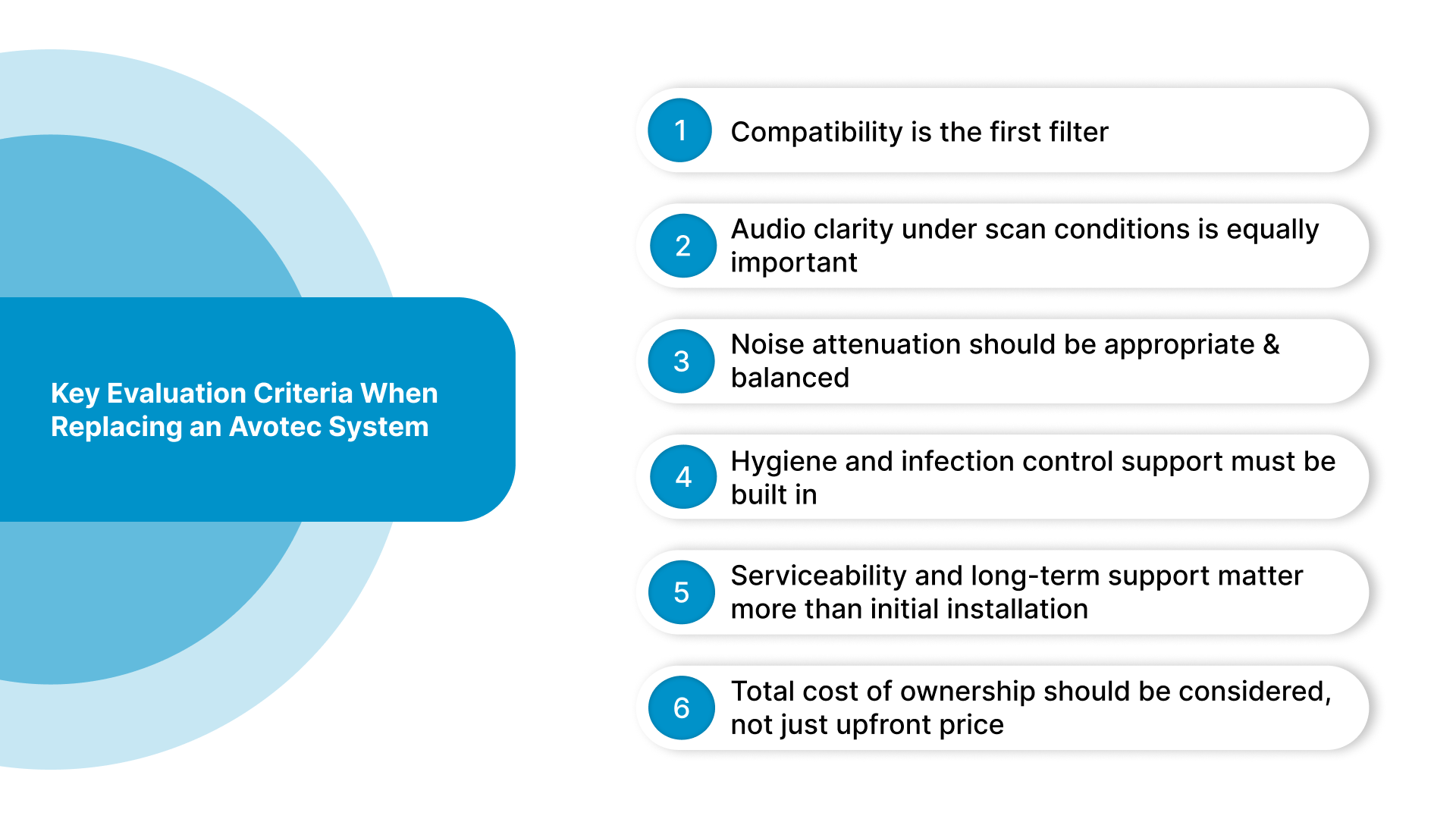
Compatibility is the first filter. Any replacement or alternative must work with the specific MRI systems already in place. This includes compatibility with scanner manufacturers, communication consoles, and existing room layouts. Audio systems that require extensive modification or introduce uncertainty during upgrades often create more disruption than value.
Audio clarity under scan conditions is equally important. MRI environments produce complex acoustic noise, and not all systems handle this well. Evaluation should focus on how clearly patients can hear technologist instructions during active sequences, not just on advertised noise reduction levels.
Noise attenuation should be appropriate and balanced. Effective systems reduce perceived scan noise without isolating patients to the point where communication becomes difficult. The goal is improved comfort while preserving intelligibility throughout the exam.
Hygiene and infection control support must be built in. Many Avotec alternatives overlook this area. Evaluation should consider whether the system supports disposable covers, cleanable surfaces, and accessories that align with facility infection control protocols, especially in high-volume imaging centers.
Serviceability and long-term support matter more than initial installation. MRI audio systems are used daily and must be easy to maintain. Readily available replacement parts, responsive support, and simple component swaps reduce downtime and extend system lifespan.
Total cost of ownership should be considered, not just upfront price. Lower initial costs can be offset by expensive consumables, limited compatibility, or frequent replacements. A strong alternative supports predictable budgeting over time.
Using these criteria allows MRI teams to compare Avotec alternatives on factors that directly affect patient experience, staff efficiency, and operational stability rather than surface-level features alone.
Review MRI headphone parts and accessories that support hygiene, clarity, and long-term use.
Common Types of Avotec Alternatives on the Market
When MRI teams begin researching Avotec alternatives, they quickly find that options fall into a few broad categories. Each type addresses MRI audio needs differently, and understanding these distinctions helps facilities set realistic expectations before comparing specific products.
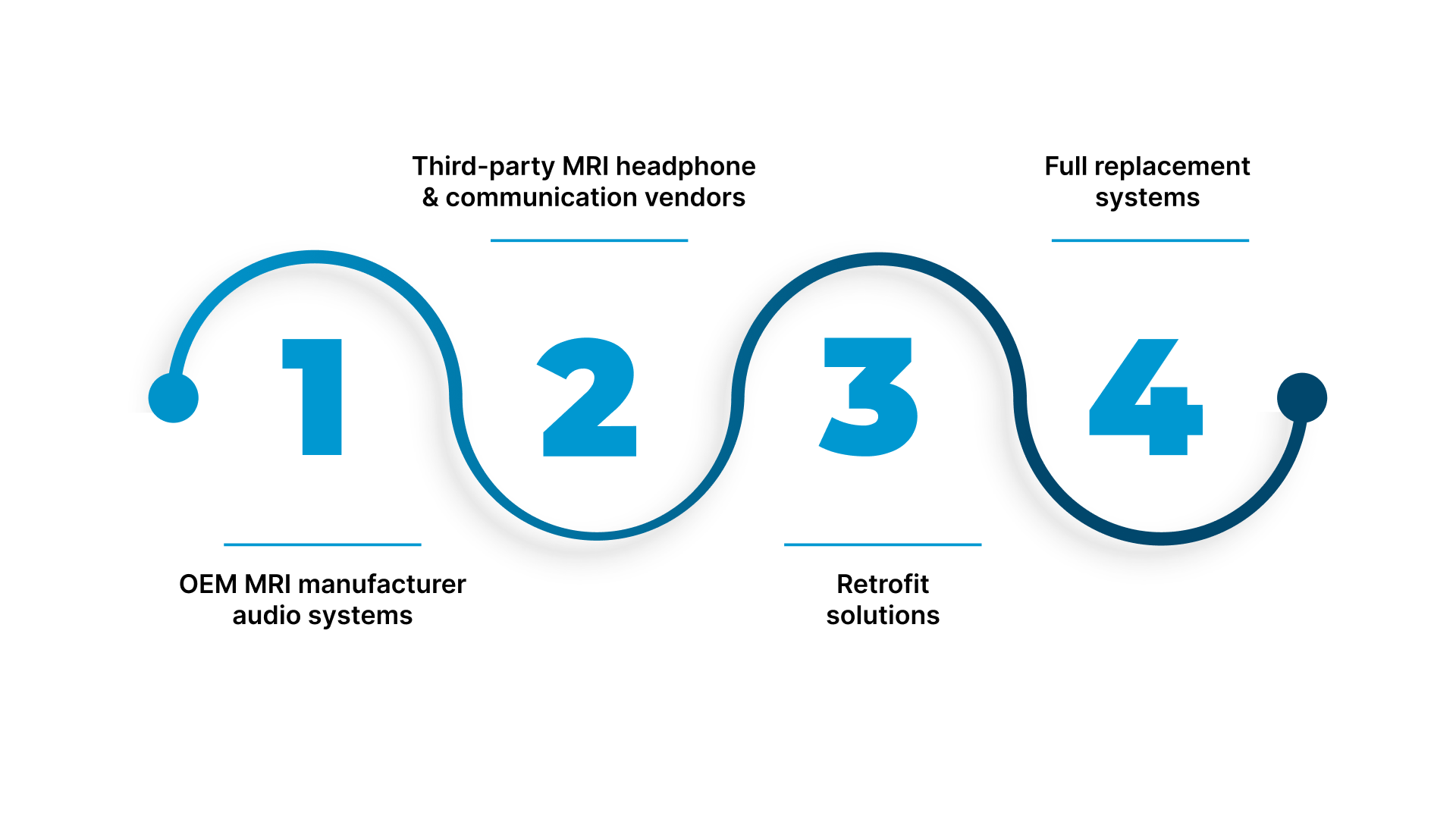
OEM MRI manufacturer audio systems are often bundled with new scanners. These systems are designed to integrate tightly with a specific MRI platform and typically offer reliable baseline performance. However, they may lack flexibility across multiple scanner models and often provide limited options for hygiene accessories or customization once installed.
Third-party MRI headphone and communication vendors focus specifically on patient audio and technologist communication. These solutions may be used as full replacements or as upgrades to existing systems. While this category offers more choice, performance varies widely. Some vendors emphasize noise attenuation without adequately addressing comfort, hygiene, or long-term serviceability.
Retrofit solutions are designed to work with existing MRI infrastructure. Instead of replacing the entire audio system, facilities upgrade specific components such as headphones, cabling, or patient interfaces. This approach can reduce disruption and cost, but success depends heavily on compatibility and accessory quality.
Full replacement systems involve removing existing audio components and installing a new end-to-end solution. This option may make sense during major room renovations or scanner replacements, but it often requires higher upfront investment, staff retraining, and careful planning to avoid downtime.
Across these categories, MRI teams often encounter recurring limitations, including:
One-size-fits-all headphone designs that do not fit all patients well
Disposable covers that degrade sound quality or comfort
Limited accessory ecosystems that restrict long-term adaptability
Recognizing these common market patterns helps facilities evaluate Avotec alternatives with clearer expectations and avoid solutions that solve one problem while creating others.
Compare modular MRI stereo system kits and accessories that work with existing setups.
Where Many Avotec Alternatives Fall Short
While there are many Avotec alternatives on the market, a closer look often reveals recurring gaps that are not immediately obvious during product demos or initial evaluations. These shortcomings tend to appear after systems are in daily use, when real-world workflow, patient diversity, and hygiene demands come into play.
One common issue is an overemphasis on noise reduction alone. Many alternatives promote high decibel reduction numbers without considering how those levels affect speech clarity. In practice, excessive attenuation can make it harder for patients to hear technologist instructions, especially during active scan sequences.
Another frequent limitation is insufficient attention to infection control. Some systems rely on generic or improvised disposable covers, while others assume cleaning protocols that are difficult to maintain in high-volume environments. When hygiene is treated as an add-on rather than a design requirement, compliance becomes inconsistent and staff burden increases.
Accessories are often treated as secondary, even though they play a major role in comfort and performance. Poorly designed ear cushions can compromise passive noise reduction, create pressure points, or fail to seal properly. Limited replacement options also force facilities into unnecessary full system changes when only small components wear out.
Many alternatives also struggle with patient variability. Pediatric, geriatric, and long-scan patients all have different comfort and communication needs, yet some systems offer little flexibility in fit or configuration. This can lead to increased motion, repeated instructions, and reduced patient satisfaction.
Finally, lack of adaptability over time is a recurring concern. Systems that work well in a single MRI room may not scale easily across different scanners or future upgrades. When flexibility is limited, facilities face higher costs and more disruption with each change in equipment or workflow.
Understanding where Avotec alternatives commonly fall short helps MRI teams identify solutions that address not only technical requirements but also the everyday realities of patient care and staff efficiency.
Suggested Read: Safely Share Headphones by using Disposable Covers
How Scan Sound Fits Into the Avotec Alternative Conversation
Scan Sound approaches MRI audio differently than many traditional Avotec-style systems. Instead of positioning itself as a closed, one-to-one replacement, Scan Sound focuses on modular, MRI-safe audio components and accessories that address the most common gaps facilities encounter when evaluating alternatives.
As a healthcare-focused, family-owned manufacturer, Scan Sound specializes in MRI-compatible headphones, cushions, cabling, and hygiene solutions designed specifically for shared clinical environments. This makes Scan Sound relevant both for facilities replacing an Avotec system and for those looking to improve performance without a full system overhaul.
Scan Sound fits into the Avotec alternative discussion in several practical ways:
Accessory-first flexibility: Facilities can upgrade headphones, cushions, or hygiene components without replacing existing communication infrastructure. This reduces disruption and allows phased improvements.
MRI-safe design across components: Products are engineered for MRI environments, supporting safe use during high-noise sequences while maintaining consistent audio performance.
Built-in support for infection control: Disposable headphone covers and cleanable accessories are designed to align with hospital and imaging center hygiene protocols rather than relying on improvised solutions.
Improved comfort and passive noise control: Properly fitted cushions and patient-facing components enhance comfort and strengthen passive noise reduction, which supports clearer communication during scans.
Compatibility across diverse MRI rooms: Scan Sound components are used in facilities with mixed scanner fleets, helping standardize patient audio experience without locking teams into a single proprietary system.
Rather than asking facilities to replace everything at once, Scan Sound supports a more adaptable path forward. This approach allows MRI teams to address communication, comfort, and hygiene challenges incrementally while maintaining operational continuity.
Explore Scan Sound’s MRI-safe headphones, cushions, and hygiene solutions.
Scan Sound vs. Traditional Avotec-Style Systems: Practical Differences
When comparing Scan Sound with traditional Avotec-style MRI audio systems, the differences are less about replacing one brand with another and more about how each approach supports daily clinical use over time.
Traditional Avotec-style systems are typically designed as closed, integrated setups. Headphones, communication hardware, and accessories are intended to function as a single package. This can simplify initial installation, but it often limits flexibility when parts wear out, hygiene standards change, or MRI rooms are upgraded.
Scan Sound follows a modular approach that allows facilities to adjust and improve specific components as needs evolve. Instead of requiring a full system change, MRI teams can address targeted issues without disrupting existing workflows.
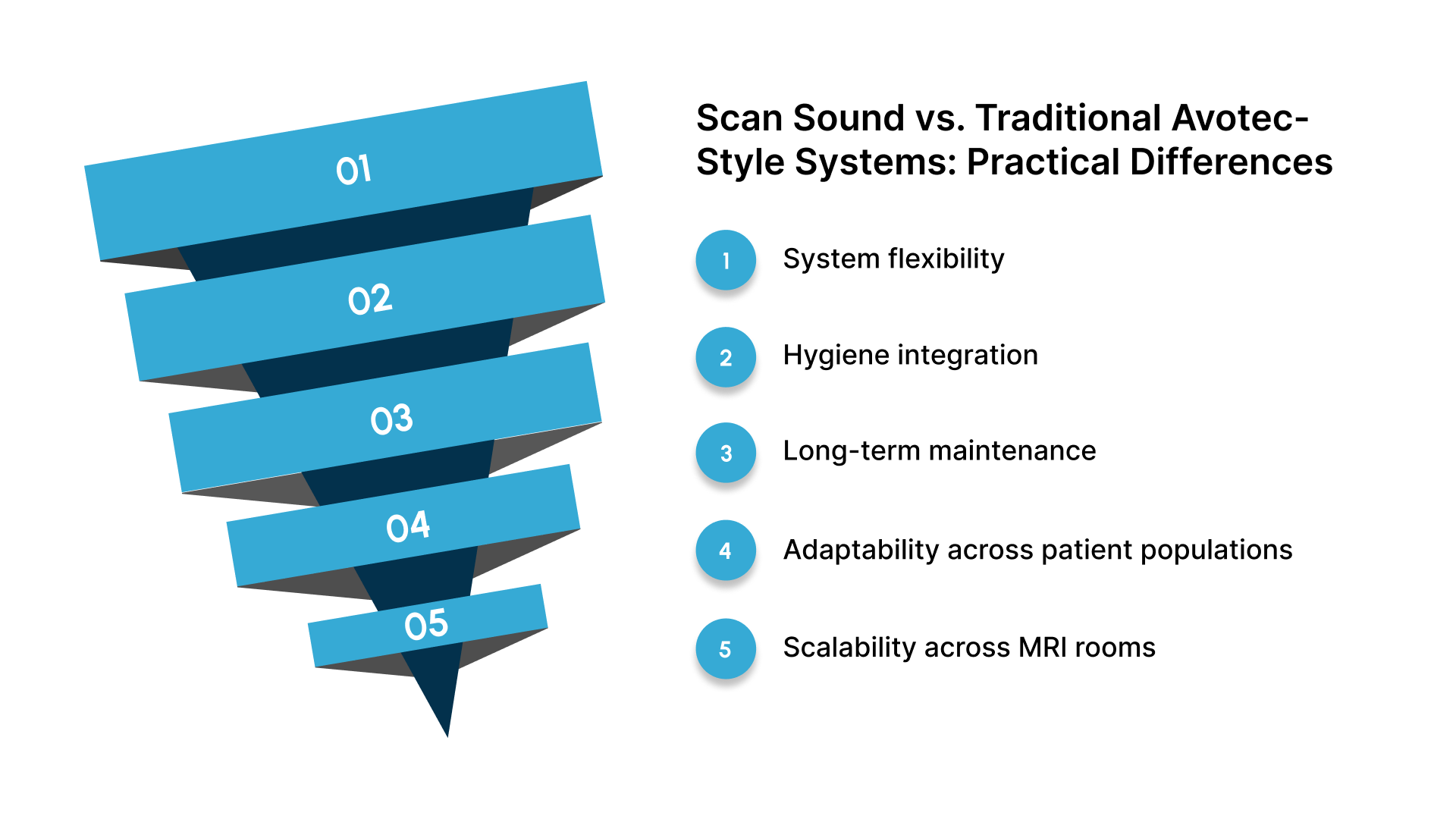
Key practical differences include:
System flexibility: Traditional systems often require like-for-like replacements within the same ecosystem. Scan Sound components can be integrated selectively, allowing upgrades without full system replacement.
Hygiene integration: Avotec-style setups may rely on basic cleaning or third-party covers. Scan Sound designs disposable covers and accessories specifically for clinical, shared-use environments.
Long-term maintenance: Closed systems can make small repairs costly or slow. Modular components simplify maintenance by allowing individual parts to be replaced as needed.
Adaptability across patient populations: Fixed designs may struggle with fit and comfort for pediatric, geriatric, or long-scan patients. Scan Sound offers accessory options that improve comfort and passive noise control across diverse patient needs.
Scalability across MRI rooms: Standardizing accessories across multiple scanners is often easier with a modular ecosystem than with proprietary, room-specific systems.
These practical differences matter most after installation, when MRI teams are balancing patient experience, staff efficiency, and long-term operational stability.
Upgrade specific MRI audio components instead of replacing entire systems.
Which Facilities Benefit Most From Switching or Supplementing Avotec
Not every MRI facility needs a full replacement when evaluating Avotec alternatives. In many cases, the greatest value comes from identifying which environments benefit most from switching systems entirely and which are better served by supplementing existing setups with targeted upgrades.
Facilities that often benefit from exploring alternatives include high-volume imaging centers where headphones and patient-facing components are used continuously throughout the day. In these settings, comfort, durability, and hygiene directly affect room turnover and staff workload.
Hospitals with strict infection control protocols also tend to benefit from re-evaluating legacy audio systems. When existing setups lack support for disposable covers or cleanable accessories, maintaining compliance becomes more difficult and inconsistent.
Facilities operating multiple MRI rooms or mixed scanner fleets often face compatibility and standardization challenges. Using adaptable audio components across rooms helps create a consistent patient experience without locking the facility into a single proprietary system.
Pediatric and long-scan environments are another strong fit. Children and patients undergoing lengthy exams are more sensitive to discomfort and communication issues. Improving fit, passive noise reduction, and clarity can reduce motion and improve scan success rates.
In contrast, facilities with stable workflows and low patient throughput may not require immediate system changes. For these teams, supplementing existing Avotec setups with improved headphones, cushions, or hygiene accessories can address key pain points without major disruption.
Understanding where a facility falls along this spectrum helps decision-makers choose the most practical path forward, whether that involves a full transition or incremental improvements.
Find MRI audio and comfort products suited for high-volume, pediatric, and multi-room facilities.
How to Transition From an Avotec System Without Disruption
Replacing or upgrading an MRI audio system does not have to mean operational downtime or major workflow changes. Many facilities successfully transition away from Avotec systems by taking a measured, step-by-step approach that prioritizes continuity of care.
The first step is a compatibility review. Before introducing any alternative components, MRI teams should confirm scanner compatibility, connection types, and communication interfaces. This ensures new headphones or accessories integrate smoothly with existing MRI infrastructure.
A phased transition strategy often reduces risk. Rather than replacing an entire system at once, facilities can begin by upgrading patient-facing components such as headphones, cushions, or hygiene accessories. This allows staff to adapt gradually while immediately improving comfort and cleanliness.
Staff familiarity and training also matter. Even small changes should be introduced with clear guidance so technologists understand setup, cleaning, and storage. Simple, intuitive components reduce the learning curve and help maintain consistent use across shifts.
Facilities should also plan for inventory and replacement workflows. Readily available consumables and spare parts prevent delays and reduce the temptation to reuse worn or compromised accessories, which can affect hygiene and performance.
For many MRI teams, starting with accessory-level upgrades provides a low-risk way to evaluate alternatives. If performance and workflow improve, facilities can then decide whether a broader system transition makes sense in the future.
A thoughtful transition approach helps MRI teams improve patient experience and operational efficiency without interrupting daily scanning schedules.
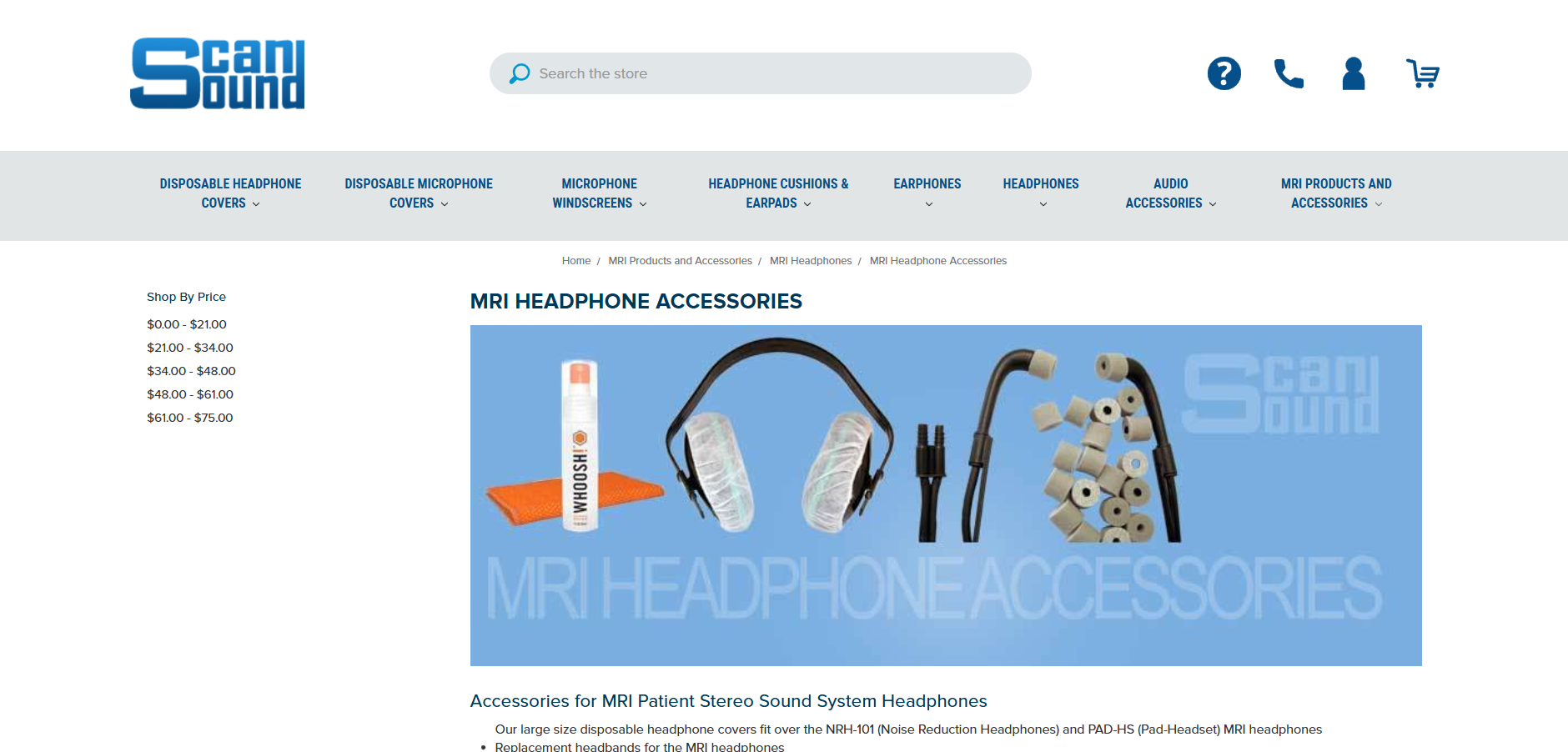
Start with accessory-level MRI audio upgrades to improve comfort and hygiene.
Conclusion
Choosing an Avotec alternative is not simply a matter of selecting a different manufacturer. The most effective MRI audio solutions are those that fit the specific clinical, operational, and hygiene needs of a facility over time.
As this guide has shown, important factors include clear patient communication during scans, balanced noise attenuation, reliable MRI-safe performance, and strong support for shared-use hygiene. Equally important is how well a system adapts to real workflows, diverse patient populations, and future changes in MRI equipment.
For many facilities, the right path forward is not an all-or-nothing replacement. Incremental improvements, especially at the accessory level, can address common pain points while preserving existing infrastructure. This approach reduces disruption and allows MRI teams to evaluate alternatives based on real-world performance rather than assumptions.
By focusing on fit, flexibility, and long-term usability, imaging centers and hospitals can make more confident decisions when moving beyond traditional Avotec-style systems. The goal is a quieter, clearer, and more comfortable MRI experience for patients and a more efficient, reliable workflow for staff.
Request guidance on MRI-safe audio compatibility, fit, and hygiene solutions.
FAQs
Q: What are Avotec alternatives typically used for?
A: Avotec alternatives are most often evaluated for MRI patient audio and communication, including headphones, patient communication clarity, and hygiene accessories. Facilities usually explore alternatives to improve comfort, infection control, compatibility, or long-term support rather than to replace all MRI room equipment.
Q: Why do imaging centers look for Avotec alternatives?
A: Imaging centers look for Avotec alternatives when clinical or operational needs change. Common reasons include stricter infection-control standards, MRI upgrades that affect compatibility, the need for better patient communication during scans, or concerns about long-term serviceability and cost of ownership.
Q: Do Avotec alternatives require replacing the entire MRI audio system?
A: Not always. Many facilities improve performance by upgrading headphones, cushions, or hygiene accessories while keeping existing communication infrastructure in place. Full system replacement is usually reserved for major room renovations or scanner upgrades.
Q: What should MRI teams prioritize when evaluating Avotec alternatives?
A: MRI teams typically prioritize MRI safety, speech clarity during scans, patient comfort, hygiene support for shared use, compatibility with existing scanners, and long-term reliability. Workflow fit and ease of maintenance are often more important than advertised noise reduction alone.
Q: Are Avotec alternatives compatible with different MRI scanner brands?
A: Some Avotec alternatives are designed to work across multiple MRI manufacturers, while others are platform-specific. Facilities with mixed scanner fleets should confirm compatibility before purchasing to avoid workflow disruption.