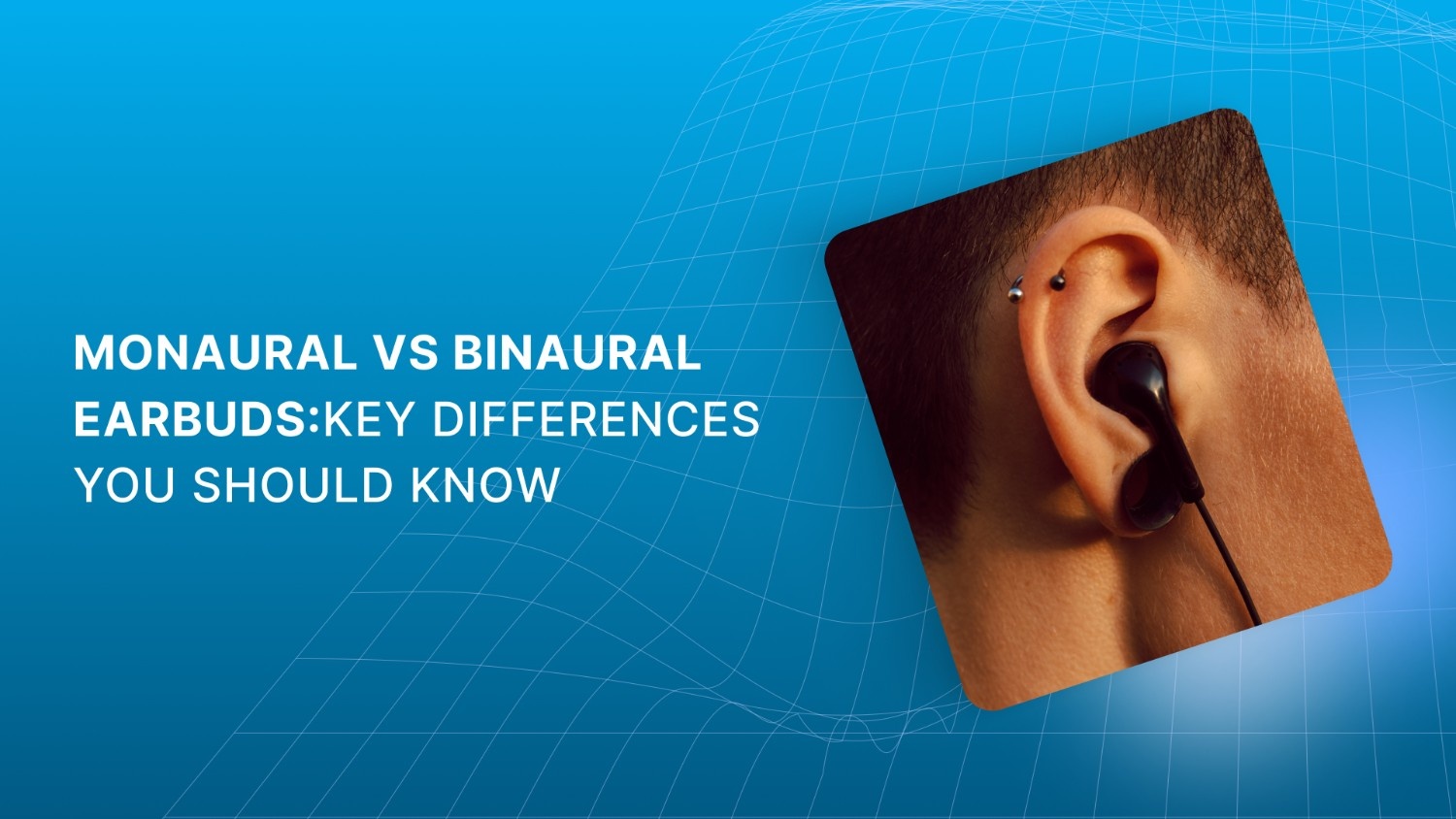
Choosing between monaural vs binaural earbuds often feels harder than it should. Specs look similar. Descriptions blur together. In professional, medical, or shared spaces, a wrong pick can hurt focus, comfort, or awareness. You may need to hear what is happening around you. Or you may need isolation to stay locked in. When does awareness matter more than blocking noise?
Research helps explain why this choice matters. In 1973, biophysicist Dr. Gerald Oster observed that sound design changes how the brain processes audio, not just how it hears it. That difference shapes perception, fatigue, and attention. So what is the key difference in monaural vs binaural earbuds and what should you choose? One prioritizes awareness. The other prioritizes focus. This guide breaks down seven clear differences so you can decide with confidence.
Read This First: The 30-Second Decision Lens
Monaural vs binaural earbuds change how you function, not how audio sounds. One keeps you connected to people and signals. The other shields attention during sustained tasks.
Sound delivery shapes fatigue and errors over time. Single-ear designs preserve spatial cues. Dual-ear designs concentrate audio load across both ears.
Noise control is situational, not a quality metric. Isolation helps in dense acoustics. Ambient awareness prevents missed cues in shared or clinical spaces.
Comfort and hygiene scale differently across shifts and users. Contact area, pressure, and cleaning effort affect endurance and compliance.
The right choice starts with environment, not preference. Match earbud design to safety demands, collaboration needs, and session length.
You now know what actually changes when earbud design changes. Before unpacking each difference in detail, it helps to see those trade-offs side by side at a glance.
Monaural vs Binaural Earbuds Compared at a Glance
Before getting into details, you need a clear snapshot. This section compares monaural vs binaural earbuds based on how they function, not which one is better. Think of this table as a quick reference. It helps you orient yourself before you examine each difference in depth.
Below is a side-by-side view of how the two designs behave in real professional and shared environments.
Comparison Factor | Monaural Earbuds | Binaural Earbuds |
Number of earpieces | One | Two |
Awareness of surroundings | High. One ear remains open to ambient sound | Low. Both ears are covered |
Noise isolation | Minimal by design | Moderate to strong depending on fit |
Typical use environments | Clinical rooms, labs, shared offices | Noisy workspaces, focused tasks |
Comfort during long use | Lighter feel, less ear pressure | More immersive but higher ear load |
Collaboration suitability | Easy verbal interaction with others | Limited without removing earbuds |
Also Read: MRI Headphones: Your Guide to a Quieter Scan
These differences influence how you stay aware, communicate, and maintain comfort during extended use. To understand why those differences matter during long use, you need to look at how each design delivers sound to your ears.
How Monaural vs Binaural Earbuds Handle Sound Delivery
Sound delivery is the foundation of this comparison. Monaural vs binaural earbuds route audio differently to your ears, and that directly shapes perception and fatigue. One approach keeps part of your natural hearing intact. The other standardizes what you hear across both ears.
Understanding this difference helps you predict how your attention and comfort will hold up during long sessions.
Monaural vs Binaural Earbuds and Single-Ear vs Dual-Ear Audio
Here is how each design delivers sound:
Audio enters one ear only.
Your open ear continues processing spatial cues.
You stay oriented to nearby voices and alerts.
Binaural earbuds
Audio is delivered evenly to both ears.
External sound is reduced or masked.
Your auditory focus stays centered on the audio source.
If awareness beats isolation for your workday, this is your pick. The 1-BUD puts monaural listening to work, clearly and simply.
This structural choice affects how quickly fatigue sets in and how aware you remain. Once you know how sound reaches your ears, the next question is what that does to your attention. That is where the balance between focus and environmental awareness starts to matter.
Focus vs Environmental Awareness in Monaural vs Binaural Earbuds
Focus and awareness sit on opposite ends of the same scale. Monaural vs binaural earbuds force you to decide where you need balance. Neither design is universally better. Each supports a different type of attention depending on your environment.
In clinical, lab, and shared workspaces, this trade-off becomes very practical.
When Monaural vs Binaural Earbuds Change Attention Levels
Here is how attention shifts with each design:
Monaural earbuds
You can hear colleagues, equipment, and room activity.
Team coordination happens without removing the earbud.
Alerts and verbal cues stay audible.
Binaural earbuds
Background interruptions drop significantly.
Mental load stays focused on one task or voice.
External conversations fade unless intentionally reintroduced.
Your environment decides which attention model supports your work instead of disrupting it.
Also Read: Sharing of Headphones and Headsets Created a Need for Disposable Covers
Attention is only half the story. Once sessions stretch longer, the way earbuds sit on your ears starts to influence comfort, fatigue, and staying power.
Endurance, Pressure, and Fatigue in Monaural vs Binaural Earbuds
Comfort affects endurance and error rates during extended use. In professional and medical settings, discomfort compounds over hours, not minutes. Monaural vs binaural earbuds distribute weight and pressure differently, which changes how quickly fatigue shows up during long shifts.
Physical Comfort Differences in Monaural vs Binaural Earbuds
Below is how comfort factors play out during prolonged use:
Weight distribution
Monaural earbuds load one ear, reducing overall head pressure.
Binaural earbuds balance weight but increase total contact area.
Pressure points
Single-ear designs minimize canal and outer-ear compression.
Dual-ear designs apply consistent pressure on both ears.
Fatigue patterns
Monaural fatigue shows as asymmetry over time.
Binaural fatigue shows as heat buildup and ear soreness.
Comfort determines whether you can maintain attention without frequent breaks.
Single-ear listening has clear advantages during calls. Scan Sound’s wired headsets apply that thinking without added complexity.
Comfort keeps you going, but clarity keeps you effective. Once fatigue is managed, the next question is how well each design handles noise and speech in your environment.
Noise Control and Speech Clarity Across Different Work Environments
Noise control depends on where you work, not product quality alone. Monaural vs binaural earbuds manage background sound differently, which directly affects speech clarity and safety. The goal is not maximum isolation. It is intelligible communication without masking critical cues.
How Monaural vs Binaural Earbuds Affect Speech Intelligibility
Here is how clarity shifts by environment:
Binaural earbuds
Reduce competing noise in loud rooms.
Improve voice separation when reverberation is high.
Support clearer speech during dense acoustic conditions.
Monaural earbuds
Preserve ambient cues that signal movement or alerts.
Reduce risk in environments where isolation is unsafe.
A 2025 study simulating hearing aid processing found speech understanding dropped sharply in reverberant spaces for all listeners, showing why isolation matters when echoes smear speech.
Once speech is clear and noise is controlled, another practical concern comes into focus. In shared and clinical settings, how earbuds are cleaned and reused becomes just as important as how they sound.
Shared Use, Cleaning Cycles, and Infection Control Considerations
Hygiene is shaped by design. Monaural vs binaural earbuds differ in surface contact, cleaning effort, and cross-use risk. In shared or clinical environments, these details affect compliance and turnaround time between users.
Monaural vs Binaural Earbuds in Shared and Clinical Settings
Key hygiene considerations include:

Surface exposure
Monaural earbuds contact fewer skin areas.
Binaural earbuds double touch points.
Cover compatibility
Single-ear designs pair easily with disposable sanitary covers.
Dual-ear designs require full-pair coverage for consistency.
Cleaning cycles
Reduced surface area shortens wipe-down time.
Larger contact zones demand stricter protocols.
These factors matter in labs, imaging suites, and training environments. Once hygiene is accounted for, the remaining step is practical application. This is where choosing monaural or binaural earbuds becomes a matter of matching design to the task at hand.
Choosing Monaural vs Binaural Earbuds by Use Case
Selection works best as a framework, not a blanket rule. Monaural vs binaural earbuds support different workflows. Matching design to the environment reduces friction and improves consistency across tasks.
Where Monaural vs Binaural Earbuds Work Best
Use these scenarios to guide your choice:

MRI and clinical environments
Monaural supports awareness of staff instructions and equipment cues.
Lower contact area aligns with hygiene protocols.
Labs and education
Monaural keeps verbal coordination intact.
Binaural suits focused instruction delivery in noisy rooms.
Call handling and monitoring
Binaural improves clarity under sustained background noise.
Monaural supports supervisor interaction without removal.
The right fit depends on how you work and what you must hear.
For tasks where isolation isn’t required but clear sound matters, this is a choice. Scan Sound’s 6-foot stereo earbuds provide consistent audio with minimal fuss.
Once you know which design fits each task, the next question is what that looks like in practice. That is where Scan Sound’s approach turns these use-case decisions into workable, real-world solutions.
Where Scan Sound Fits into the Monaural vs Binaural Earbuds Decision
Once you understand the trade-offs, the next step is applying them in real environments. Scan Sound fits where audio choice affects safety, comfort, and consistency rather than preference. This matters most in medical, clinical, and shared professional settings where constraints are non-negotiable.
Here is how Scan Sound supports informed choices in the monaural vs binaural earbuds decision:
Purpose-built monaural listening options: Products like the 1-BUD Single-Ear Stereo Earphones, 1-BUD Classic Earphones, 1-BUD-Pro Earphone, and Gold-Series 1-BUD Earphones apply single-ear design where awareness must be preserved. These models electronically mix left and right channels into one earpiece, supporting communication without full isolation.
Specialized designs for professional and mobile use: The 1-BUD Headset for Cell Phones, MEP-201 Model Earphones, MXP Model Studio-Quality Earphones, and Over-the-Ear Earpiece address hands-free calling, monitoring, and extended wear in controlled environments where consistency and comfort matter.
Binaural and stereo options for focused listening: Wired Stereo Earphones and 6-foot Cord Stereo Earphones support scenarios where dual-ear audio is appropriate, offering reliable wired performance without battery or pairing concerns.
Hygiene and shared-use compatibility: Accessories such as earbud eartips and compatible disposable covers support infection control and fast turnover in clinical, lab, and training environments.
Across these products, Scan Sound applies professional-grade audio design built for long sessions, predictable performance, and regulated use cases, helping you match earbud design to environment demands rather than assumptions.
Conclusion
Monaural vs binaural earbuds is not a preference question. It is a context decision shaped by sound delivery, awareness, comfort, hygiene, and noise control. The seven differences covered here show how each design behaves under real working conditions. When you choose, align the earbud design with your environment, safety needs, and endurance demands. That match matters more than any single feature.
Scan Sound has spent decades designing audio solutions for medical and professional environments where these choices carry real consequences.
Need help matching the right earbud design to your use case? Contact Scan Sound to discuss your environment and requirements with our team.
FAQs
Q: Can monaural vs binaural earbuds affect compliance in regulated work environments?
A: Yes. Some regulated spaces require awareness of verbal instructions or alarms. Earbud design can influence whether you stay compliant during active tasks.
Q: How does monaural vs binaural earbuds choice impact training and onboarding scenarios?
A: During training, you often need to hear both audio instructions and live guidance. Earbud design can either support or slow real-time learning.
Q: Are monaural vs binaural earbuds handled differently in shared equipment inventories?
A: Yes. Inventory teams consider cleaning time, replacement cycles, and accessory compatibility. Design affects how quickly earbuds can be reassigned safely.
Q: Do monaural vs binaural earbuds change error risk in task-heavy workflows?
A: They can. Tasks requiring coordination or movement benefit from audible cues, while isolated audio can increase missed signals in some workflows.
Q: How do monaural vs binaural earbuds influence supervisor visibility and oversight?
A: Supervisors rely on quick verbal exchanges. Certain earbud designs allow faster interaction without interrupting active tasks or removing equipment.
Q: Can monaural vs binaural earbuds affect long-term equipment costs?
A: Yes. Differences in wear patterns, accessories, and cleaning protocols can shift replacement frequency and operational costs over time.